Longevity - Mechanics
- Author
- Nazım
- Published
- Modified
On this page
From the Plate to the Chromosome: How Longevity Actually Works
Motivation
If someone wants to learn to swim, the ocean is a bad place to start. Start where the water is shallow: no waves, feet on the sand, half the body still dry. Learn to float before you learn to go anywhere.
Longevity writing has the opposite problem. Almost everything written for the general reader starts in the deep end: a diagram of the electron transport chain on page one, a list of eleven supplements on page two, and by page three you are drowning in acronyms while three separate authors tell you to eat more protein and less protein at the same time.
So this post is the shallow end. One ladder, one rung at a time, from the food on your plate to the chromosome in your nucleus — and at every rung, the same question: what is the body actually doing, and what can I change about it by Thursday?
One idea holds the whole ladder up, and it is worth stating before any of the biology. Your body has two modes, and they are not "diet A" and "diet B" — they are abundance and scarcity. In abundance it grows, stores and builds. In scarcity it repairs, recycles and cleans. Both are necessary. Almost every mistake in modern eating is not a bad food; it is spending the whole day, every day, in mode one, so the repair shift never clocks on. Abundance is not the enemy. Abundance as a default is.
Everything below is a variation on that sentence.
Introduction: the clinic of Hygieia
"Life is short, the art long."
— Hippocrates, Aphorisms, I.1
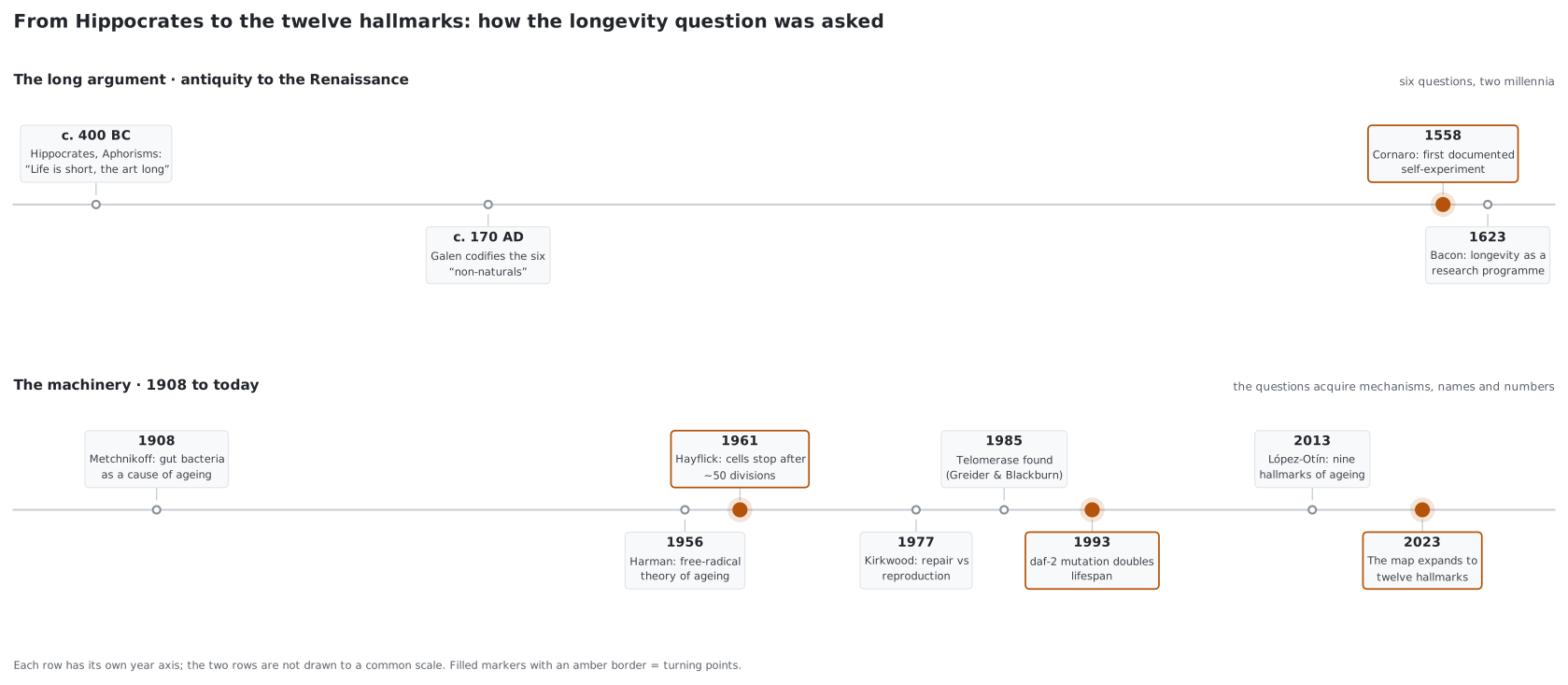
Hippocrates wrote that as the first line of the Aphorisms, and twenty-five centuries later we are still arguing about the second half of the sentence: how long can the art make the life?
Ask the Greeks where longevity lives and they would not send you to a pharmacy. They would send you to a family of gods. Asclepius had two daughters. Panacea cured the sick; Hygieia kept the healthy from needing her sister at all. Modern medicine built an empire in Panacea's name and a modest clinic in Hygieia's. This post is about Hygieia's clinic — a discipline that is only now acquiring a scientific vocabulary: the deliberate maintenance of a body that is not yet broken.
The ancient prescription was astonishingly complete. Galen of Pergamon, in the second century CE, organised prevention around six factors external to the body but subject to our will — the "non-naturals": food and drink, air and environment, motion and rest, sleep and waking, retention and excretion, and the passions of the mind [1] [2]. Read that list again, then read the table of contents of any longevity book published this year. Six items, two millennia, one list. What changed is not the questions but the resolution: we can now say what a mitochondrion is doing at three in the morning, and why the seventh hour at a desk writes a mark onto a histone.
The ancients also left us the two competing explanations of why we die, and modern biology kept both, in different clothes. Aristotle, in his short treatises on youth, old age, life and death, likened life to a lamp: the flame burns while the oil and the innate heat last, and gutters when the moisture is used up. Life, on that view, is a fuel budget. Others reached for the second image — a wick that slowly clogs with soot. Both are right. Energy metabolism and damage accumulation are two halves of every mechanism in this post, and the modern names for the soot would please a Greek: reactive oxygen species, crosslinked proteins, methylated cytosines in the wrong place.
Then comes the first documented self-experiment. In 1558 a Venetian nobleman, Luigi Cornaro, published Discorsi della vita sobria — the account of a wrecked man who cut his food to about twelve ounces and his wine to fourteen, recovered, and then spent four more decades publishing progressively boastful updates [3] [4]. His age is genuinely disputed: conventional biographies make him a near-centenarian, while an analysis of his own birth declaration puts his death nearer eighty-two [3] [4]. Either way, the argument is the interesting part. Nietzsche's objection was the sharp one — that a slow metabolism may have permitted the spare diet, rather than the diet producing the long life; consequence mistaken for cause [4]. Cornaro is nevertheless the acknowledged ancestor of caloric-restriction research: a single uncontrolled self-report that set the question we are still testing, in better designs, four and a half centuries later.
Sixty-five years later Francis Bacon wrote his History of Life and Death, treating longevity as a research programme with variables to be isolated rather than a virtue to be admired. And in 1908, Élie Metchnikoff — already a Nobel laureate for his work on immunity — gave the field both a book, The Prolongation of Life, and its first modern hypothesis: that old age comes from slow poisoning by the bacteria of our own large intestine, and could be pushed back with sour milk [5] [6]. He had noticed that rural populations living largely on fermented milk were reputed to be exceptionally long-lived, identified a bacterium he named Lactobacillus bulgaricus, drank the milk himself, and proposed that lactic-acid bacteria could suppress the protein-rotting "autointoxication" of the colon [7] [6] [8]. Paris queued for yogurt; the front pages edited out his caveats [6]. Metchnikoff died at seventy-one, which his critics found amusing. A century later, dysbiosis was formally added to the list of hallmarks of ageing [9] — and the joke is on the critics.
The twentieth century then did something Cornaro could not: it found the machinery. Harman's free-radical theory in 1956. Hayflick's discovery in 1961 that a human cell divides only about fifty times before stopping. Kirkwood's plain arithmetic of a body allocating resources between repair and reproduction. In 1993 a single mutation in a worm's insulin receptor doubled its life — the first proof that the rate of ageing is tunable rather than merely endured. Telomerase. And in 2013, a paper that gave the field something it badly lacked: a shared map. López-Otín and colleagues listed nine hallmarks of ageing; a decade later the map had twelve — genomic instability, telomere attrition, epigenetic alterations, loss of proteostasis, disabled macroautophagy, deregulated nutrient sensing, mitochondrial dysfunction, cellular senescence, stem cell exhaustion, altered intercellular communication, chronic inflammation and dysbiosis — with the last three added in 2023 [9] [10].
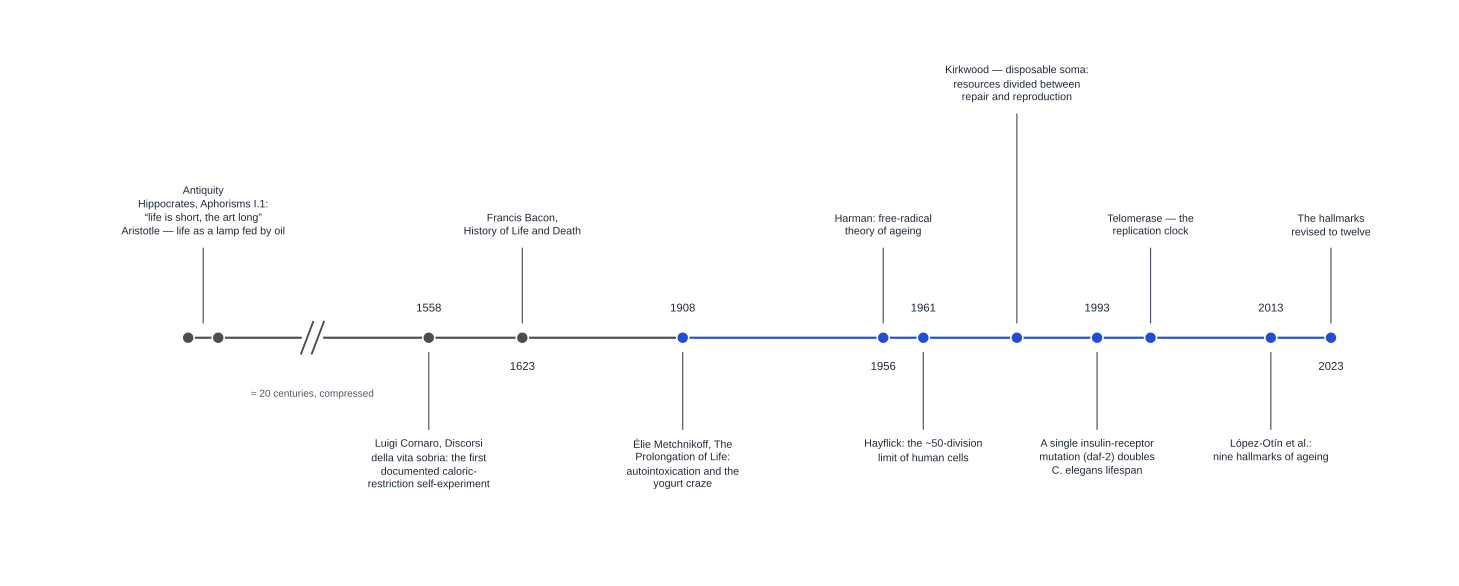
Twenty-five centuries of asking the same question, with the resolution improving at the end. Dark grey marks the pre-modern era (antiquity, 1558, 1623) and one blue accent the molecular era from 1908 on; a compressed-axis break marks the long flat stretch from antiquity to 1558, and the scale widens after 1900 so the twentieth-century cluster stays legible.
One honest caveat, and it is not a small one. The hallmarks "overlap, operate at different levels of biological organisation, and differ in causal evidence, measurability, reversibility and proximity to clinical outcomes" [9]. They are a taxonomy for research, not a checklist you can be tested against. The framework has given experiments a common language; it has not given you a score.
So where does that leave us? Not with a pill. What has genuinely changed is that the levers at the bottom of the pyramid are no longer vague advice — they have names, doses, mechanisms and measurable outputs. Most of them are free, and all of them fit on Galen's list. Let us start swimming.
The one big idea: you are built for scarcity
Every cell in your body runs a budget meeting, continuously, and the outcome of the meeting depends on one input: is fuel arriving, or is it not?
When fuel is arriving — and especially when insulin is high — the cell is told: grow. Build protein, store fat, divide if you can. When fuel is absent, and the energy gauge inside the cell falls, the cell is told: repair. Stop building, start recycling, clean up the misfolded proteins, dismantle the damaged mitochondria, tighten the chromatin, mend the DNA.
The signalling that decides this is done by four sensors, and they are the subject of Part III:
| Sensor | Sensitive to | In abundance | In scarcity |
|---|---|---|---|
| Insulin / IGF-1 | glucose, amino acids, energy surplus | high → growth | low → repair |
| mTORC1 | amino acids, insulin, energy | on → protein synthesis, autophagy off | off → autophagy on |
| AMPK | falling ATP, rising AMP/ADP | low | on → catabolism, mTORC1 inhibited |
| Sirtuins (SIRT1/3/6) | NAD⁺ availability | low activity | on → deacetylate, repress, repair |
Two states, not two diets. Now, why would a body be built this way? Because for essentially all of evolutionary time, food was intermittent and the alternative to repairing yourself was dying before you reproduced. The pathways that sense adversity were selected because they worked [11]. What is new is that in a modern food environment, abundance is the default — and so the scarcity mode, which is where most of the maintenance happens, is a mode you now have to deliberately enter.
This is the concept called hormesis: a moderate stress that turns on repair. Exercise, fasting, cold, heat and even certain plant compounds are not four different interventions. They are the same intervention with different delivery mechanisms.
Important
The dose is the whole message. A brief, repeatable stress that ends in recovery is a signal. The same stress sustained indefinitely is a disease — chronic inflammation, chronic cortisol, chronic hyperinsulinaemia. Never confuse hormesis with permanent hardship.
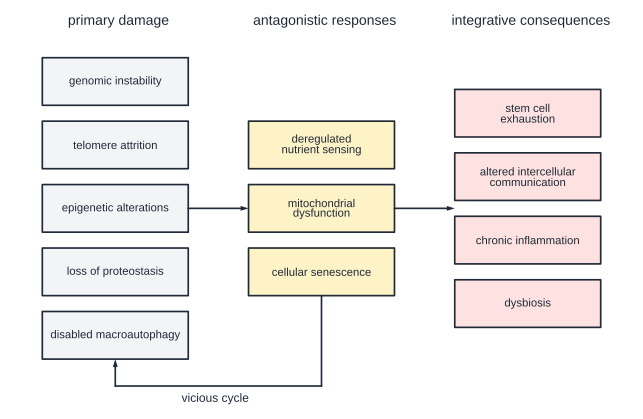
The twelve hallmarks of ageing, grouped by role rather than by importance. Primary damage (grey) feeds the antagonistic responses (amber), whose outputs combine into the integrative consequences (red); the return path marks the vicious cycle in which the responses themselves deepen the primary damage.
Part I — From the plate to the blood
1. Food is not fuel first. It is a message.
The question "is this food good for me?" is usually answered with a list. Lists are forgettable. Instead, use four decision rules; they will get you through any supermarket on earth without a spreadsheet.
Rule 1 — Did it grow? If the thing in your hand either grew somewhere or was made by fermenting something that grew somewhere, you are probably fine. This is crude, and it works far better than it has any right to.
Rule 2 — Read the fibre column, not the calorie column. Fibre is the part of a plant you cannot digest, and it is what your gut bacteria do digest. It slows glucose entry, feeds the microbiome, and is the single best available proxy for "this is a whole food". A useful ratio is fibre per 100 kcal; anything above roughly 3–4 g per 100 kcal tends to be a real food.
Rule 3 — Watch the delivery speed, not just the ingredient. The same sugar arrives very differently as an orange, a juice, or a fizzy drink. Removing water, removing fibre and removing the need to chew all accelerate delivery to the bloodstream, and the faster the delivery, the larger the insulin response for the same grams.
Rule 4 — Ask what had to be added to make you keep eating. The defining feature of a hyper-palatable food is not that it is high in sugar or fat. It is that it has been engineered so that the reward signal outruns the satiety signal: dense calories, soft texture, little fibre, rapid absorption, and a flavour profile that does not exist in nature.
This is not a moral claim about willpower. It has been measured. In a randomised controlled crossover trial, twenty adults spent two weeks on an ultra-processed diet and two weeks on an unprocessed diet, with the two diets matched for calories, sugar, fat, fibre, sodium and macronutrients offered, and free to eat as much as they wanted. On the ultra-processed diet they ate about 500 kcal per day more and gained close to a kilogram; on the unprocessed diet they lost weight [12]. They also ate faster — more calories per minute — and reported the two diets as equally palatable, without any awareness of being hungrier [12].
The same person, the same kitchen, the same rules, the same macro label: only the matrix of the food changed, and the body's own satiety accounting broke. The failure was in the environment, not in the character.
Tip
The five-ingredient test: if the label needs more than five items, or if any of them is a sugar under a different name (syrup, dextrose, maltose, juice concentrate, "evaporated cane juice"), you are probably holding Rule 4.
What to keep on the good side of the ledger: fibre and fermented foods (for the microbiome, §10), polyphenols and colourful plants, potassium and magnesium, omega-3 fats, and adequate but not excessive protein. What to treat as exceptions rather than staples: liquid sugar, refined starch, and anything with a cartoon on it.
2. The first thing you can change: AGEs
Of all the interventions in this post, this is the one where you can improve the outcome within a single dinner, using equipment you already own.
What glycation is. A reducing sugar — glucose, fructose, and their relatives — has a reactive carbonyl group. When it bumps into the amino group of a lysine or arginine residue on a protein, it forms a reversible Schiff base — a handshake, easily let go. That rearranges into a more stable Amadori product — the same handshake after a few coffees, much harder to break. That is not yet a disaster; it is exactly what HbA1c is: glycated haemoglobin, the standard three-month readout of your blood sugar. Given enough time, further rearrangements, oxidations and cross-links turn it into advanced glycation end products (AGEs) — irreversible, structurally disruptive, and chemically sticky.
A glycated collagen molecule cross-linked to its neighbour does not stretch the way it used to. It is a spot-weld between two fibres that were meant to slide past each other. That is one of the most literal mechanisms of stiffening arteries, stiffening lenses and stiffening skin. In human tissue the dominant accumulated crosslink is glucosepane [13] — a weld almost nobody outside the field has heard of, quietly setting for decades.
There are two factories, and you control both.
The endogenous factory makes AGEs from your own blood glucose, at a rate that depends on how high and for how long your glucose runs. Lower glucose excursions, lower production.
The dietary factory is the underrated one. AGEs are made by the Maillard reaction during cooking — the same chemistry that browns a steak. Which means the AGE content of a food is not a fixed property of the animal or the plant. It is a property of what you did to it. That same chicken breast, cooked two different ways, differs by a factor of six: roasted with skin for 45 minutes, 6 639 units of CML per 100 g; microwaved skinless for 5 minutes, 1 524 [14].
The pattern is consistent across every study in the review: high temperature with low moisture makes AGEs; low temperature with high moisture does not [14]. Roasting, broiling, grilling and frying are the offenders; boiling, poaching, stewing and steaming are the safe methods. Even the microwave is exonerated, mostly because it is fast — a six-minute microwave cook does not give the chemistry enough time [14].
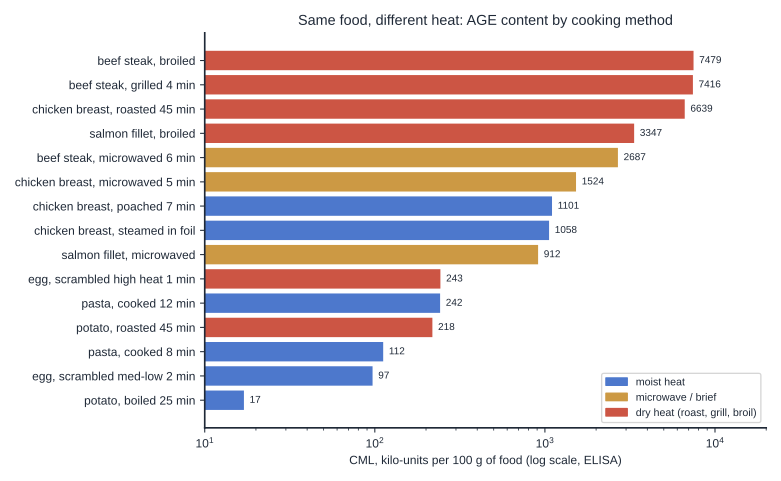
Your grandmother's technique knowledge is not sentimentality; it is process control. Stews, soups, poached fish and steamed vegetables were the dominant cooking methods of most of human history, because fuel was expensive and pots were covered. Dry, high-heat browning is a luxury that became a default.
Warning
AGE numbers are method-dependent and must never be compared across papers. The figures above are ELISA, in kilo-units of CML per 100 g of food; other studies report LC-MS in mg per kg of food or mg per 100 g of protein — physically different units answering subtly different questions [14]. Quote one method at a time, and never subtract one from the other.
Does it matter clinically? The human evidence is mixed, which is more informative than a clean answer. For: four weeks of a low-AGE diet improved insulin sensitivity in overweight women [13]; a double-blind randomised crossover trial in healthy overweight adults found the same [13]; oral AGE restriction ameliorated insulin resistance in obese people with metabolic syndrome [13]; and in type 2 diabetes, AGE restriction improved insulin resistance with a suggested involvement of AGER1 and SIRT1 [13] — note that name, because SIRT1 comes back in Part III. Against: a four-week high-AGE diet did not impair glucose metabolism or vascular function in obese individuals [13], and a systematic review concluded that the benefits of AGE-restricted diets in humans remain unclear [15].
There is also a reason the question is muddier than the cooking advice. Not all ingested CML behaves the same way: the free, unbound fraction is absorbed and largely excreted by the kidney, while the protein-bound fraction travels further down the gut and reaches the colon, where it meets the microbiome [14]. Which AGE you are counting, and where it ends up, are two different questions.
Where does that leave you? The interventions that reduce dietary AGEs — moist heat, lower temperatures, shorter cooking, acid marinades, not charring — are also, almost without exception, the interventions that preserve nutrients, avoid burnt fat and make food taste good in a quieter way. When the mechanism is unsettled but the direction of the advice is aligned with everything else we know, the low-risk answer is to take it.
The endogenous side, in practice. Keep post-meal glucose peaks modest: eat protein and fat with carbohydrates rather than instead of, add acid and fibre, take a short walk after the largest meal, and use the oldest trick there is — stop eating before you are full. If you take one number away from this section, take this one: the area under the glucose curve is what builds the irreversible crosslinks, and it is governed more by how you eat than by how much.
3. When to eat — the other half of "how"
If food is a message, then the absence of food is also a message, and it is a different one.
The four dials respond not to the total daily calories but to their distribution in time. Every meal turns mTORC1 on; every meal suppresses AMPK; every meal raises insulin. If you eat from seven in the morning until ten at night, the growth signal never really goes off, and the repair signal never really comes on. This is why time-restricted eating produces metabolic improvements that are not fully explained by the calories removed.
Practical version, no dogma:
- An eating window of roughly 10–12 hours, most days. For most people that means breakfast later, dinner earlier, and the evening kitchen closed.
- The last meal 2–3 hours before sleep. Late eating is metabolically different from the same food eaten at noon, and it also damages sleep quality, which damages everything downstream.
- No grazing. Every snack restarts the clock. If the point of an eating window is a long stretch of low insulin and active autophagy, three snacks a day cancel it.
- Front-load the day if you can. Metabolic control is generally better in the morning than at night.
- Regularity beats heroism. The systems that read these signals include your circadian clocks, and clocks want the same input at the same time daily.
Caution
If you are pregnant, underweight, living with type 1 diabetes or on glucose-lowering medication, an eating window is a medical decision, not a lifestyle tweak. Talk to a physician first.
Tip: Takeaway for Thursday
Cook tonight's protein with moist heat instead of dry heat, keep the eating window to about twelve hours, and walk for ten minutes after the largest meal. Three changes, one day, no supplements.
Part II — From the blood to the mitochondrion
4. Making ATP: how fuel becomes energy
Now the food is in the blood. Follow one glucose molecule.
Stage 0 — the doorway. Insulin is the key that tells a muscle or fat cell to move its glucose transporters (GLUT4) to the membrane. The same insulin is a growth and storage signal. Notice that the switch that lets fuel in is the same switch that says store it. That is not a coincidence and it is not a bug — it is the design.
Stage 1 — glycolysis (cytosol). Glucose, a six-carbon sugar, is split into two three-carbon pyruvate molecules, with a small net profit of 2 ATP and 2 NADH. No oxygen needed. This is the ancient pathway, and it is why you can sprint before you can breathe.
Stage 2 — the gate. Pyruvate enters the mitochondrion and is converted to acetyl-CoA, losing a carbon as CO₂. This is the most important crossroads in metabolism: acetyl-CoA either enters the TCA cycle and is burned, or is exported and used to build things — fat, cholesterol, and the acetyl marks on histones (§8). Whether a carbon is burned or built is a decision, and insulin plus the mitochondrial state make it [16].
Stage 3 — the TCA cycle. Acetyl-CoA is oxidised through a ring of eight reactions, stripping off high-energy electrons and handing them to carriers: 3 NADH, 1 FADH₂ and 1 GTP per turn.
Stage 4 — the electron transport chain and chemiosmosis. The carriers drop their electrons onto protein complexes in the inner mitochondrial membrane. The electrons are passed down a chain, and at three points the passage pumps protons outward — building a proton gradient across the membrane, a literal electrochemical battery. The protons then flow back through a rotary motor, ATP synthase, and each turn phosphorylates ADP to ATP. Oxygen is the final electron acceptor; water is the exhaust.
The accounting, using the modern convention of 2.5 ATP per NADH and 1.5 per FADH₂ [17]:
- Glucose → 30–32 ATP per molecule (the range is the cytosolic NADH shuttle).
- Palmitate (C16:0) → 106 ATP per molecule, from eight acetyl-CoAs and seven rounds of β-oxidation.
Per molecule, fat wins 3.5 to 1. Per gram — the number that matters on a plate — fat is 2.48× denser in ATP than glucose: 413 versus 167 mmol of ATP per gram of fuel [17].
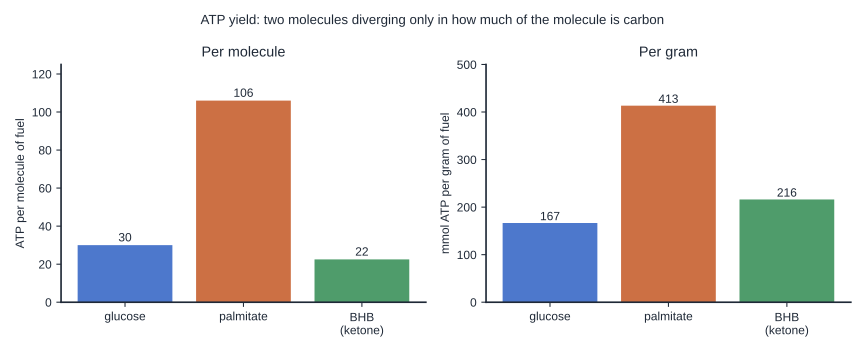
That is the whole reason fat is the body's storage currency and glycogen is only the petty cash: glycogen capacity is small, so surplus energy goes to fat, and fat is the densest chemical battery you can carry. Whether it accumulates over months is decided by chronic energy balance; insulin decides where the flow goes today, not whether the books balance.
How much ATP do you actually make? At an assumed 2 000 kcal/day of energy expenditure and a cellular free energy of ATP hydrolysis of 50–60 kJ/mol, an adult hydrolyses and remakes roughly 139–167 mol of ATP per day — about 70–85 kg, which is to say, on the order of your own body mass, every single day [17]. You are not a body that contains energy; you are a machine that rebuilds itself continuously, and the maintenance bill is enormous.
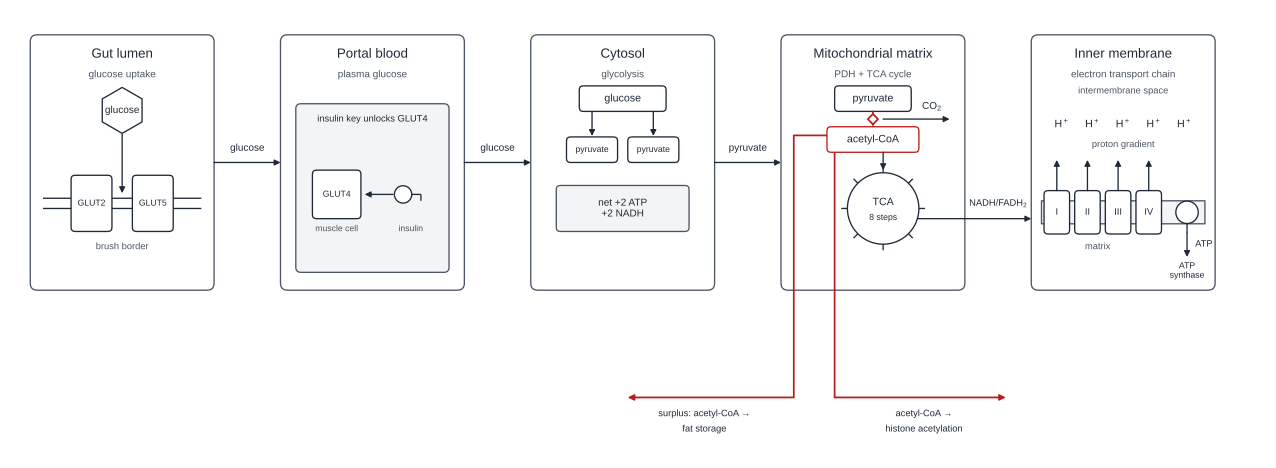
One glucose molecule's route from the gut lumen to ATP: uptake through the brush border, insulin-dependent entry into muscle, glycolysis in the cytosol, the pyruvate gate and the eight-step TCA ring in the matrix, and the electron transport chain with its proton gradient and ATP synthase. The two red markers are the decision points — the pyruvate gate and the acetyl-CoA branch — whose surplus acetyl-CoA can go to fat storage or to histone acetylation.
5. Living with the exhaust
Nothing in this section is free. Burning fuel leaks.
Electrons occasionally escape the chain — mainly at complexes I and III — and attach to oxygen prematurely, making superoxide. This is why mitochondria are both the engine and the smokestack.
Here is the part that the "antioxidants are good" intuition gets wrong. At low, transient concentrations, reactive oxygen species are signals. They trigger the cell's own antioxidant enzymes, they participate in the adaptation to exercise, and they are part of how the cell knows it has been working. Blunt that signal and you blunt the benefit. This is exactly what happened in a randomised trial of 54 young adults training for eleven weeks: those given 1 000 mg vitamin C plus 235 mg vitamin E per day — shop-shelf doses — showed no increase in the mitochondrial biogenesis markers that rose in the placebo group, and their endurance adaptation was blunted [18] [19]. In older men doing strength training, the same combination blunted gains in lean mass [19].
At high, chronic concentrations, the same molecules are simply damage. And mitochondrial DNA sits inside the danger zone, right beside the electron transport chain, wrapped in less protective packaging than nuclear DNA and with weaker repair. This is why mitochondrial dysfunction earns its own hallmarks box [9].
The maintenance toolkit — this is what "keeping your mitochondria healthy" actually means:
- Fusion and fission. Mitochondria are not discrete beans; they are a constantly remodelling network that merges to share contents and divides to segregate damage. A healthy network is a dynamic one.
- Mitophagy. Damaged mitochondria that cannot be repaired are flagged and digested — a specialised form of the autophagy we meet in §7.
- Biogenesis. New mitochondria are built on demand, and the master regulator is PGC-1α, induced by endurance exercise and by falling energy charge.
- Not overfeeding it. A mitochondrion that is never asked to work hard and is never given a rest does not remodel well.
The practical conclusion is the opposite of the supplement aisle: challenge the mitochondria (exercise, brief fasts, temperature), let them rest, and do not chemically muffle their signals.
Tip: Takeaway for Thursday
Do something today that makes your mitochondria work and then lets them rest: one hard-ish effort or one long easy one, then an actual night's sleep. Skip the antioxidant megadose.
Part III — The four dials
6. The control panel, and what NAD⁺ has to do with it
Four systems decide, minute by minute, whether you are in build mode or repair mode. None of them is a single whole-body switch — more on that in a moment.
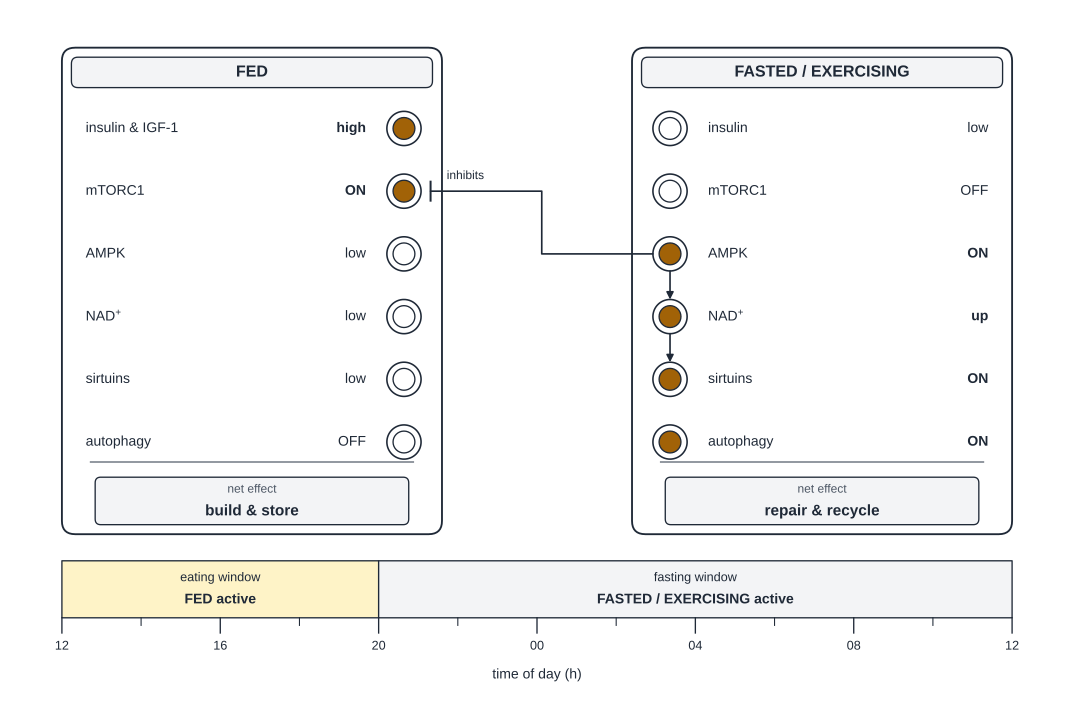
The two modes side by side: a lit lamp marks the pathways engaged in that state, so the FED column shows mTORC1 ON with AMPK and sirtuins low, while the FASTED / EXERCISING column mirrors it. Arrows carry the cross-talk — AMPK inhibits mTORC1 (bar-ended wire) and drives NAD and sirtuins — and the 24 h axis below (noon to noon) settles which column is active.
Insulin / IGF-1 signalling (IIS). This was the first longevity pathway ever discovered in animals, and it was discovered by accident. The critical experiment: a single mutation in daf-2, the worm's insulin/IGF-1 receptor, roughly doubled C. elegans lifespan. A hormone pathway that everybody assumed was about sugar turned out to set the rate of ageing. In humans the pathway is more complicated — and insulin resistance, not low insulin, is the modern pathology — but the principle survives: chronic high IIS drives growth at the expense of maintenance.
mTORC1. The master anabolic switch. Amino acids, insulin and ample energy turn it on, and it then drives protein synthesis, cell growth and proliferation — and it switches autophagy off. This is the direct mechanical reason fasting and protein restriction increase autophagy: you cannot be building and demolishing at the same time, and the cell chooses building when nutrients are present.
Important
mTOR is not a villain. You want it on after resistance training, briefly, to build and retain muscle. What you do not want is a signal that is on from breakfast to bedtime, seven days a week, for forty years. On at the right time, off the rest of the time.
AMPK. The energy gauge. When ATP falls and AMP rises, AMPK switches the cell into catabolism: burn fat, take up glucose, inhibit mTORC1, and — this detail matters — it also raises NAD⁺ synthesis [20]. Exercise is the cleanest AMPK activator there is.
Sirtuins. SIRT1, SIRT3, SIRT6 and their relatives are enzymes that remove acetyl groups from histones and other proteins. They are NAD⁺-dependent, which is the sentence that connects this section to the next one.
NAD⁺, properly understood. Nicotinamide adenine dinucleotide is two things at once, and conflating them has caused enormous confusion:
- It is the cell's principal electron carrier — NAD⁺ accepts electrons (becoming NADH) in glycolysis and the TCA cycle and delivers them to the electron transport chain.
- It is a consumed substrate for enzymes that use it as a reagent, not a cofactor they hand back: sirtuins (deacetylation) and PARPs (DNA repair).
The second role is what makes NAD⁺ a longevity molecule. If NAD⁺ is low, the sirtuins are sitting at their desks with no raw material, and PARP enzymes strip NAD⁺ away to repair DNA damage. That sets up a loop worth memorising: damage → PARP activation → NAD⁺ consumption → weaker sirtuin repression → more damage.
How is NAD⁺ made? Three routes: de novo from the amino acid tryptophan; the Preiss–Handler pathway from nicotinic acid; and — the one that matters most in mammals — the salvage pathway, which recycles nicotinamide back into NAD⁺. The rate-limiting enzyme of salvage is NAMPT, and you should remember that name for a practical reason [20] [21]. It is also the reason the precursor question is not as simple as it sounds: NR and NMN are raw material fed into the salvage pathway upstream of NAMPT, so supplying more substrate does not fix a bottleneck that is the enzyme itself.
What happens with age, and what actually works. Tissue NAD⁺ does decline with age, but the most interesting results are not about pills. The strongest and most actionable finding is this: skeletal-muscle NAD⁺ tracks how much you move. In cross-sectional work, NAD⁺ was lower in older muscle, lowest in physically impaired older adults, and closest to young levels in those who trained regularly [22].
And here is the mechanism, with numbers. Twelve weeks of training raised NAMPT — the rate-limiting salvage enzyme — by about 12% in young adults and 28% in older adults with aerobic training, and by about 25% (young) and 30% (older) with resistance training; in the older group, training restored NAMPT to the levels seen in young muscle [21] [20]. Exercise raises NAD⁺ largely by rebuilding the machinery that recycles it [20].
Tip
Before buying a NAD⁺ precursor, buy a pair of shoes. The evidence that exercise raises muscle NAD⁺, NAMPT and sirtuin activity is solid [20] [21]. The evidence that oral precursors translate into human health outcomes is thin, tissue-specific and still being gathered — and commercial interest in the question is enormous.
The protein question: cycling, not suppression
Two facts that look like a contradiction:
- mTORC1 on means growth and no autophagy, and a chronically high mTORC1 signal is part of the pro-ageing pattern.
- Muscle is built by mTORC1, and losing muscle is one of the most reliable predictors of disability and death in later life.
Both are true, and the conflict dissolves once you ask what shape the signal takes rather than how big it is.
First: nothing here is one whole-body switch. The dials are read per tissue and per hour. On a training day, the muscle you just loaded is anabolic — mTORC1 on, protein synthesis up — while the liver is simultaneously catabolic, running gluconeogenesis and, if you are fasted, ketogenesis. "Anabolic muscle, catabolic liver" is not a paradox; it is an ordinary Tuesday. Any advice of the form "keep mTOR low" has to say where and when.
Second: pulsatile beats chronic. mTORC1 that spikes after resistance training and after a protein-containing meal, then falls again, is the adaptive pattern — that spike is the signal that tells muscle to rebuild. mTORC1 that is on from breakfast to bedtime, because you graze and because insulin never returns to baseline, is the pro-ageing pattern. Not because the molecule is bad, but because the repair shift never gets a turn.
So the protocol is cycling, and the cycle matters more with age:
- Two or three protein pulses a day, not a continuous trickle. Each pulse should carry enough leucine — commonly quoted at roughly 2.5–3 g, which lands around 25–40 g of a high-quality protein — to actually flip the switch in older muscle.
- After 60, cycling beats chronic suppression. The anabolic resistance of ageing means the same dose of protein produces a smaller muscle-building response, so deliberately under-eating protein to "keep mTOR down" is one of the few genuinely dangerous pieces of longevity advice for an older reader.
- Do not under-eat protein. The figures commonly quoted for older adults run higher than the general recommendation, roughly 1.0–1.2 g per kg of body weight per day, spread across those pulses.
- Keep the fasting window genuinely free of protein. The cycling only works if the "off" phase is actually off; a handful of nuts every ninety minutes is the chronic pattern wearing a healthy costume.
The muscle-and-protein dose deserves its own post. The one-line version: mTOR is a switch to be cycled, not a villain to be suppressed.
7. The cleaning shift: autophagy
While mTORC1 is on, the cell builds. When it goes off, a remarkable thing happens: the cell starts eating itself, on purpose, and in an orderly way.
Autophagy — literally "self-eating" — is the recycling system. A double membrane forms around worn-out proteins, damaged organelles or debris, seals into an autophagosome (think of it as a rubbish bag the cell ties shut around its own junk), and fuses with a lysosome, which is the incinerator, where the contents are digested back into amino acids and reused. There are three variants worth knowing by name: macroautophagy (the bulk route), mitophagy (specifically for mitochondria), and chaperone-mediated autophagy (for individual proteins carrying the right signal) [23] [24].
Proteostasis — protein quality control — is the broader project: chaperones that fold proteins correctly, the proteasome that destroys individual bad ones, and autophagy that handles the bulk. When it fails, the garbage accumulates as the protein aggregates of neurodegeneration. This is why loss of proteostasis and disabled macroautophagy are separate hallmarks of ageing, and why the 2023 update had to add autophagy explicitly — a decade of data forced it [9].
The control logic, in three lines:
- mTORC1 on → autophagy off. Nutrients present; no need to recycle.
- AMPK on and mTORC1 off → autophagy on. Energy low; scavenge.
- NAD⁺ up, sirtuins active → deacetylation of autophagy machinery → autophagy on. This is the SIRT1 connection in the AGE trial from §2.
Why it belongs in a longevity post. Because the dials are readable in your own day. Fasting and caloric restriction trigger autophagy; so does exercise; so, in different tissues, do heat and cold. But notice something important about how fasting works: the benefit comes mainly from the absence of food — the restoration of an ancient scarcity signal — and not from calorie arithmetic alone [25].
And note again that these dials are not a single body-wide switch. During a fast, your liver is deep in the catabolic column while a muscle that was just trained is still in the anabolic one; during a long walk at the end of an overnight fast, the two states coexist in the same body. The question is never "which mode am I in?" but "which mode is this tissue in, right now, and for how long?"
Note
A common question: "how long do I have to fast for autophagy?" The honest answer is that the precise kinetics are tissue-specific, difficult to measure in living humans, and heavily studied in mice — and there is currently no validated human biomarker for autophagy initiation. Time-restricted eating and overnight fasts reliably shift the dials; the exact hour at which your liver crosses a threshold is not something anyone can tell you with confidence.
Tip: Takeaway for Thursday
Move before you buy. Exercise, not a precursor, is the intervention with the best evidence for raising muscle NAD⁺ [20] [21]; and eat your protein in two or three good pulses rather than grazing on it all day.
Part IV — The archive
8. DNA and its librarians
You have roughly two metres of DNA in each of your cells' nuclei, and a nucleus about six micrometres across. The packing problem is solved by histones.
DNA winds about 1.7 turns — roughly 147 base pairs — around an octamer of eight histone proteins (two each of H2A, H2B, H3 and H4). That unit is a nucleosome. Strings of nucleosomes coil further into chromatin, and chromatin exists in two functional states: euchromatin, open and transcriptionally active, and heterochromatin, condensed, tightly packed, and largely silenced.
Here is the crucial point that ties this post together. Which state a region is in is not decided by the DNA sequence. It is decided by chemical marks — acetyl and methyl groups — written onto the histone tails and onto the DNA itself. And those marks are written by enzymes that run on cofactors derived from your diet:
| Enzyme family | Job | Cofactor it consumes | Comes from |
|---|---|---|---|
| Sirtuins | remove acetyl marks | NAD⁺ | salvage pathway (NAMPT), exercise ↑ |
| Histone acetyltransferases (HATs) | add acetyl marks → open | acetyl-CoA | glucose, fat, ketones |
| Methyltransferases | add methyl marks → silence | SAM (S-adenosylmethionine) | methionine, folate, B₁₂, choline |
| TET / JmjC demethylases | remove methyl marks → open | α-ketoglutarate | TCA cycle |
Read the table once more. Food is not just fuel that gets burned. Food is ink. Your metabolic state determines which enzymes have their cofactor, and therefore which pages of the genome are readable today. When acetyl-CoA is plentiful — fed state — HATs can mark and open chromatin, while sirtuins (needing NAD⁺, plentiful in the fasted state) do the opposite. The genome is not a fixed script. It is a library with a circulation policy that changes with your metabolism.
9. Why the book stays open
Your question was the right one to ask, and it deserves a precise answer rather than a metaphor: why do the chromatin regions open, why do they close again, and why does the open time grow as we age?
Why regions open and close at all. This is normal and essential. Every cell in your body carries the same genome, but a neuron and a hepatocyte express different genes because different regions are accessible in each. A region opens when a transcription factor or a polymerase needs to read a gene, and closes when it is done. Marks are written and erased, methyl groups added and removed, the nucleosome repositions. A closed region costs nothing to maintain and prevents accidental transcription; an open one does work. The cycle is the cell's daily business.
What goes wrong is not a timer; it is fidelity. The best-supported model of chromatin ageing is epigenetic drift: the accumulation of small, unplanned changes in the marks, so that cells gradually wander away from their ideal epigenetic state [26]. Carry the library picture over from §8 and it becomes concrete: heterochromatin is the closed stack, H3K9me3 is the padlock that keeps it shut, HP1 is the keeper who walks the aisles checking it, and transposable elements are the manuscripts that must never be reprinted. Ageing, in this picture, is not a clock running down; it is a slow loss of housekeeping discipline. Three things drive it:
- Damage and repair. At a DNA double-strand break, chromatin must transiently open so that repair machinery can get in — rapid, local heterochromatin compaction around breaks is a required part of the repair sequence. Repair is usually faithful. But repeated repair at the same locus, and the competition between repair enzymes and transcription factors arriving at a reconfigured site, can leave what has been called a cumulative "epigenetic scar" — orphaned histone or DNA modifications that nobody removes, because nobody knows they are there [27]. That is your "longer opening": not a clock running slow, but a repair site that never fully tidies up.
- Heterochromatin erosion. With age, the repressive mark H3K9me3 — the padlock — and its reader protein HP1 decline, core histone levels fall, and heterochromatin loses integrity: measurably, as increased accessibility at H3K9me3-marked domains [28] [29] [30].
- A vicious loop through transposable elements. Transposable elements make up about half of the mammalian genome, and they are normally locked inside heterochromatin [26]. When that lock weakens, they are transcribed — the printing press in the basement starts running again — and LINE-1 RNA can inhibit SUV39H1, the enzyme that makes the padlock, globally reducing the mark that was silencing the element in the first place [30]. LINE-1 itself is a retrotransposon: a stretch of DNA with a photocopier built into it, able to paste new copies of itself elsewhere in the genome.
Why it is dangerous — and why "more open" is not automatically good. Three consequences: leaky expression of genes that should be silent, including developmental genes long since switched off; transposon activation, with insertional and inflammatory effects; and a progressive loss of cell identity, with cells drifting into stress-responsive transcriptional states [28] [30]. The costs are linked. A cell that has forgotten which pages it is supposed to read loses the thing that made it a hepatocyte rather than a fibroblast; and DNA and RNA turning up where they should not be is, to the innate immune system, an alarm. That alarm is one of the routes by which chromatin drift feeds chronic inflammation, the hallmark we meet in §10. In the ageing brain, this heterochromatin decay and transposon activation are most pronounced in glutamatergic neurons of regions like the frontal cortex and hippocampus — the anatomy of cognitive decline, in the language of chromatin [28].
Can it be prevented or reversed? Partly measured, and worth stating precisely. Interventions that reduce damage to the genome reduce the repair traffic that leaves scars: this is where everything from §2 onward converges — lower glucose, lower dietary AGEs, adequate NAD⁺, good sleep, exercise. The more speculative end is partial reprogramming: transient expression of the Yamanaka factors partially reverses epigenetic marks in cells and mice. It is real, it is early, and it is not a protocol. The honest summary: the drift is real, some of the drivers are things you control, and no one can yet hand you a number for how much of it you can undo.
Finally, the measurement. DNA-methylation clocks — GrimAge, DunedinPACE and their relatives — use patterns of methylation to estimate biological age, and they are genuinely useful research instruments [26]. They are not diagnoses.
Caution
Do not make a medical decision on the basis of a commercial epigenetic age test. The hallmarks framework explicitly does not function as a validated clinical score [9].
Tip: Takeaway for Thursday
Sleep is when the librarians work: the repair traffic, the mark-writing and the mark-erasing all run on the night shift. Protect the seven-to-nine hours before you investigate anything more exotic.
Part V — The neighbourhood, and the body
10. Zombie cells, smouldering fires, and the gut
Three of the twelve hallmarks are not inside any single cell.
Cellular senescence. A cell that has accumulated enough damage can stop dividing — a tumour-suppression mechanism that is genuinely protective early on. But senescent cells do not die. They sit there and secrete a cocktail of inflammatory signals, growth factors and proteases called the SASP (senescence-associated secretory phenotype). A modest number is handled by the immune system; as the immune system ages and the numbers grow, the SASP becomes a chronic irritant to the whole tissue. Hence the nickname "zombie cells".
Chronic inflammation — "inflammaging". Low-grade, persistent, systemic inflammation is now a hallmark in its own right, added in 2023 [9]. It sits at the intersection of everything: senescent cells feed it, visceral fat feeds it, the gut feeds it, and it feeds back into insulin resistance, mitochondrial dysfunction and further senescence. It is also the mechanism through which most of the "lifestyle" variables act.
Dysbiosis. The third 2023 addition [9], and the direct descendant of Metchnikoff's 1908 hypothesis. The composition and metabolic output of the gut microbiome shifts with age and with diet, and short-chain fatty acids such as butyrate are central to maintaining the intestinal barrier and modulating inflammation. Fibre feeds the bacteria that make them; fermented foods add live organisms; polyphenols are metabolised by the same community into active compounds.
Note
The hallmarks framework is not only molecular. Work including López-Otín's own places psychosocial factors — social connection, chronic stress, socioeconomic disadvantage — in the same picture, with social disadvantage associated with accelerated biological ageing [10]. Loneliness is not a soft variable. It is in the mechanism.
11. Movement and rest
If this post has an argument, it is that the body's repair systems are switched by scarcity signals, and that the most reliable way to produce a well-dosed scarcity signal on purpose is exercise. Two modes, for two different reasons.
Resistance training — because muscle is not vanity, it is metabolic infrastructure. It is the largest glucose sink in the body, it is where much of the NAD⁺/NAMPT story plays out, and muscle mass and strength in later life predict independence. It is also the one place where you want mTORC1 on: the post-training anabolic window is a deliberate visit to the "abundant" column. Protein intake must be adequate for this to work, which is where "less protein for mTOR" advice gets misapplied — see the protein question above. For a 75-year-old trying to hold onto muscle, that advice is not merely wrong; it is backwards.
Aerobic training, mostly easy — because this is what builds mitochondria. Zone 2 (comfortable, conversational, most days) drives PGC-1α, mitochondrial biogenesis, AMPK activation and NAMPT induction. This is the mechanism by which "cardio" becomes "longevity": it is not just burning calories, it is expanding and maintaining the machinery that processes them.
Some hard efforts occasionally — because cardiorespiratory fitness is one of the strongest predictors of mortality that exists. In 122 007 adults who underwent treadmill exercise testing, fitness was inversely related to mortality across the entire range, with no plateau: elite fitness was associated with roughly an 80% reduction in mortality risk compared with the lowest-fitness group, and the risk associated with poor fitness was comparable to or greater than that of coronary artery disease, diabetes or smoking [31] [32]. The categories were graded, and every step up counted [33].
Sleep and circadian rhythm. Sleep is when much of the repair happens; it is also when the glymphatic clearance of the brain is most active and when growth-hormone pulses occur. Regular light exposure in the morning and darkness at night is not wellness trivia — it sets the clocks that time every other process in this post. Late, bright, calorie-dense evenings are the modern environment's way of keeping you in one mode permanently.
Heat and cold. Sauna, hot baths, cold exposure and even a genuinely cold shower are hormetic stimuli: transient, recoverable stress that induces heat-shock proteins and other adaptive responses. The human outcome evidence is thinner than the mechanistic story, but they are cheap, they are pleasant, and they fit the framing.
Tip: Takeaway for Thursday
Two resistance sessions and two easy aerobic sessions this week beat any stack you can order. And put one social appointment in the calendar — loneliness belongs in the mechanism [10].
The protocol: what to actually do on Monday
One day
| Time | Action | Why |
|---|---|---|
| Morning | Bright light within an hour of waking | sets the circadian clock |
| Morning | Delay the first meal to give a 12-hour overnight fast | low insulin, AMPK on, autophagy window |
| With meals | Protein + fat + fibre + acid; eat slowly | flattens the glucose curve, less endogenous glycation |
| Cooking | Moist heat, lower temperature, no charring | cuts dietary AGEs several-fold |
| After eating | 10–15 minutes of walking | clears post-meal glucose |
| Afternoon | 10-minute movement snack every hour of sitting | AMPK, glucose disposal |
| Evening | Last meal 2–3 hours before bed | metabolic and sleep quality |
| Night | Dark, cool, same bedtime | repair mode, hormonal rhythm |
One week
- 2–3 resistance sessions (enough that it is hard; a little more than last week).
- 2–3 easy aerobic sessions (30–45 min, conversational pace).
- One long walk (60–90 min, unhurried).
- One fasting stretch you can genuinely sustain — a 14–16 hour overnight fast once or twice, not a heroic stunt.
- Protein in two or three pulses a day, adequate rather than minimal, especially after 60.
- Fibre and fermented foods daily; ultra-processed food out of the house, because the trial says the environment beats the will [12].
- Screen for loneliness as seriously as you screen for blood pressure [10].
What to measure (and what these numbers are): proxies, not hallmarks [9].
| Marker | What it reflects | Frequency |
|---|---|---|
| Waist circumference / waist-to-height ratio | visceral fat, insulin resistance | monthly |
| Fasting glucose, HbA1c, HOMA-IR | endogenous glycation load | 6–12 months |
| hs-CRP | chronic inflammation | yearly |
| ApoB / lipids | cardiovascular risk | yearly |
| Uric acid | fructose and metabolic load | yearly |
| Grip strength | muscle, a robust predictor of outcomes | 6 months |
| VO₂max (or a field test estimate) | cardiorespiratory fitness [31] | 6 months |
| Sleep duration and regularity | the substrate of everything above | continuous |
What we do not know
A post like this has an obligation to end with the honest part.
- The hallmarks are a taxonomy, not a diagnosis. They overlap, differ in causal support, and their causal priority in human ageing is unresolved [9]. No test measures them, and no score summarises them.
- Mouse lifespan is not human lifespan. A long list of interventions extends mouse life and has failed to translate. No intervention discussed here has been shown, in a properly controlled human trial, to extend maximum lifespan.
- The AGE evidence is genuinely mixed, including a null high-AGE trial [13] [15].
- NAD⁺ precursors raise NAD⁺ in blood reliably, but blood NAD⁺ is a poor proxy for tissue, and outcome data are still thin [22]. The exercise route has better mechanistic evidence [20] [21], and it works on the step that actually declines — NAMPT.
- There is no validated human biomarker for autophagy initiation, so any claim about "how much autophagy you have switched on" is an extrapolation, not a measurement.
- I have deliberately not discussed specific supplements and doses, because the human evidence for most of them, at the doses sold, does not justify the confidence with which they are sold.
Conclusion
Hippocrates was right about the proportions: the art is long, and we are each of us short. But the art is no longer vague. It has names now — AMPK, NAMPT, H3K9me3, glucosepane — and, more importantly, it has a shape: two modes, and a body designed to spend most of its time in the second one.
There is nothing in this post that Galen would have found surprising. Food and drink, air and environment, motion and rest, sleep and waking, retention and excretion, and the passions of the mind — six items, and every mechanism above is an explanation of why that list is right. What he lacked was resolution. He could not have known that the act of browning a steak creates a crosslink that stiffens an artery forty years later, or that the enzyme sitting on your histones waiting for NAD⁺ is the same one a fasting rat switches on in a laboratory in 1990.
So here is the shallow end, in one line: most of your genome's maintenance runs on scarcity signals, and most of modern life removes them. Movement, an eating window, real food, sleep, and a bit of discomfort on purpose. That is the whole sea. Learning to float on it is a matter of repetition, not of heroism — and the water is not as deep as it looks.
Comments
No comments yet. Be the first to comment!